

What Is Artificial Intelligence (AI)? A Complete Guide for Beginners
Artificial Intelligence, commonly called AI, has become one of the most important technologies in the modern world. From chatbots and voice assistants to recommendation systems and smart devices, AI is already part of many everyday activities.
You may have used AI without even realizing it. When your phone recognizes your face, a streaming service recommends a movie, or a chatbot answers a question, artificial intelligence may be working behind the scenes.
But what exactly is AI? How does it work? What can it actually do, and what are its limitations?
In this guide, we will explain what Artificial Intelligence is, how it works, its major types, common applications, benefits, challenges, and future possibilities in simple language.
What Is Artificial Intelligence?
Artificial Intelligence is a branch of computer science focused on creating systems that can perform tasks that normally require some form of human intelligence.
These tasks can include:
- Understanding language
- Recognizing images and sounds
- Finding patterns in data
- Solving problems
- Making predictions
- Learning from information
- Generating text, images, audio, or other content
A traditional computer program usually follows instructions written by a developer. An AI system can also use data and learned patterns to produce an output based on the situation it encounters.
For example, an email application can use AI to identify whether a new message is likely to be spam. It does not simply look for one specific word. Instead, a trained system can examine many characteristics of a message and estimate whether it resembles previously identified spam.
How Does Artificial Intelligence Work?
AI does not work through a single technology. It combines several concepts, including data, algorithms, computing power, and different learning techniques.
At a basic level, an AI system can be understood through the following process:
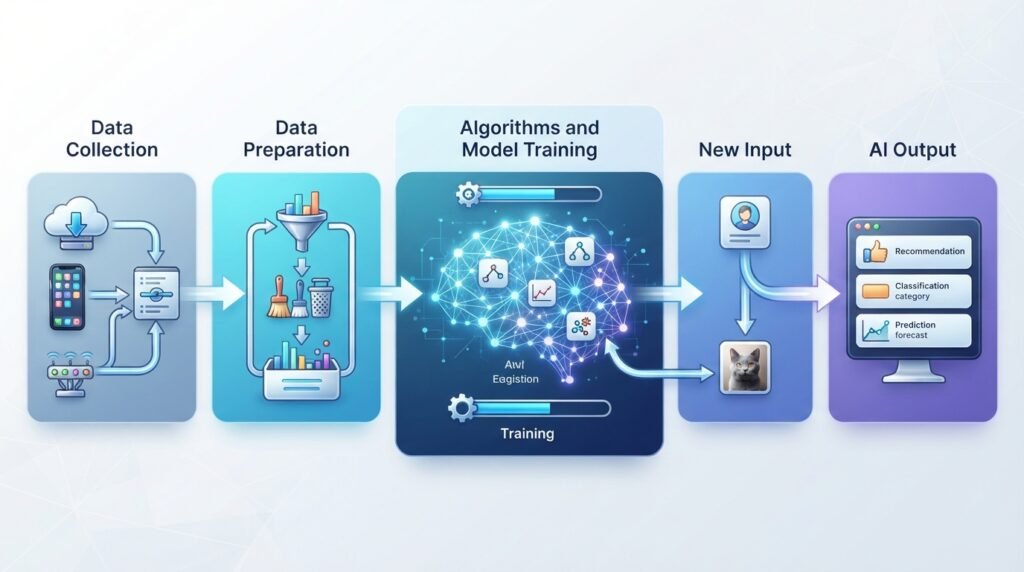
- Data is collected from suitable sources.
- The data is prepared so that a system can process it.
- An algorithm or model analyzes patterns within the information.
- The model is trained or configured to perform a particular task.
- New information is provided to the system.
- The AI produces an output, such as a prediction, classification, recommendation, or generated response.
The Role of Data
Data is extremely important for many AI systems. Depending on the application, this data can include text, images, audio, video, numbers, or other digital information.
For example, an image-recognition system may be trained using a large collection of labeled images. During training, the system can learn patterns that help it distinguish between different objects.
The quality of the data matters as well. Poor, incomplete, or biased data can negatively affect an AI system’s results.
The Role of Algorithms
An algorithm is a set of instructions or mathematical procedures used to process information and solve a problem.
AI algorithms help systems identify patterns, make predictions, classify information, or generate outputs.
Different problems require different approaches. An algorithm designed to identify objects in photographs may work very differently from one used to recommend products.
Machine Learning and AI
Machine Learning is one of the most important areas within AI.
Instead of programming every possible decision manually, machine learning allows a system to learn patterns from data and use those patterns when processing new information.
For example, a music recommendation system can analyze listening behavior and discover relationships between songs, artists, and user preferences. It can then use those patterns to suggest music that a listener may enjoy.
Types of Artificial Intelligence
AI is often discussed in terms of its capabilities. The commonly described categories include Narrow AI, Artificial General Intelligence, and Artificial Superintelligence.
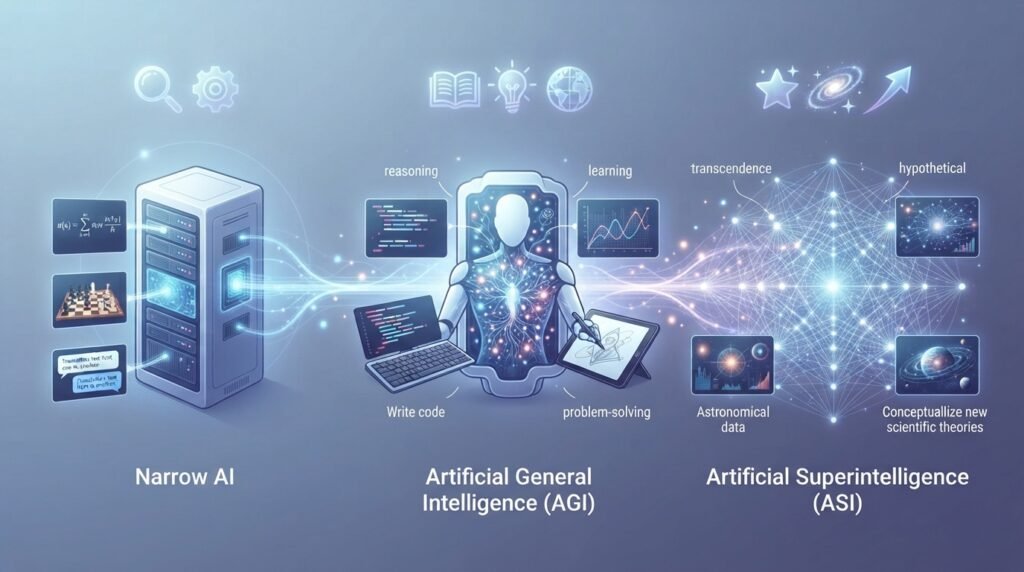
| Type | Description | Current Status |
| Narrow AI | Designed to perform specific tasks | Widely used today |
| Artificial General Intelligence (AGI) | A theoretical system with broad human-like intellectual abilities | Not achieved |
| Artificial Superintelligence (ASI) | A theoretical intelligence that would greatly exceed human capabilities | Hypothetical |
Narrow AI
Narrow AI, also known as weak AI, is designed for a specific purpose or a limited group of related tasks.
Examples include:
- Voice recognition
- Spam detection
- Search recommendations
- Image classification
- Translation systems
- Navigation applications
- Product recommendations
Most AI systems people interact with today fall into this category.
A system can be extremely capable at its particular task without possessing general human intelligence.
Artificial General Intelligence
Artificial General Intelligence (AGI) refers to a hypothetical type of AI that could understand, learn, and apply knowledge across a wide range of intellectual tasks at a level comparable to humans.
An AGI system would not be limited to one narrow function. In theory, it could transfer knowledge between different kinds of problems and adapt to unfamiliar situations.
AGI remains a research goal rather than an established technology.
Artificial Superintelligence
Artificial Superintelligence (ASI) is a hypothetical concept describing an AI system whose intellectual capabilities would substantially exceed those of humans across a broad range of areas.
ASI is mainly discussed in theoretical and future-oriented conversations about advanced AI.
Common Applications of Artificial Intelligence
AI is already used across many industries. Its applications range from simple automation to complex systems that analyze large amounts of information.
AI in Smartphones
Modern smartphones can use AI for several functions, such as:
- Face and object recognition
- Voice assistants
- Camera image processing
- Predictive text
- App recommendations
- Battery and performance optimization
Many of these features operate automatically, so users may not notice that AI is involved.
AI in Healthcare
AI can assist healthcare professionals with tasks involving data analysis, medical imaging, research, and administrative workflows.
For example, machine-learning systems can be developed to identify patterns in medical images that may require further examination.
AI can support professionals, but it does not automatically replace medical expertise. High-stakes decisions require appropriate human oversight and validation.
AI in Education
Educational platforms can use AI to provide personalized learning experiences.
Possible applications include:
- Adaptive learning systems
- Automated feedback
- Language-learning tools
- Study assistants
- Content recommendations
- Learning progress analysis
These tools can help students practice and understand concepts, although human teachers remain important for instruction, context, and judgment.
AI in Business
Businesses use AI to analyze information, automate repetitive processes, understand customer behavior, and improve decision-making.
Common examples include:
- Customer support chatbots
- Fraud detection
- Sales forecasting
- Recommendation systems
- Document processing
- Business analytics
The exact role of AI depends on the company’s needs and the quality of the available data.
AI in Transportation
AI is used in transportation for tasks such as route planning, traffic prediction, driver assistance, and logistics optimization.
Navigation applications, for example, can analyze traffic information and suggest routes that may reduce travel time.
AI in Entertainment
Streaming and social platforms use recommendation systems to determine which content may be relevant to individual users.
Recommendations can be influenced by factors such as:
- Previous activity
- Search behavior
- Content preferences
- Similar users’ behavior
- Characteristics of the content
This is one reason two people using the same service may receive very different recommendations.
Benefits of Artificial Intelligence
AI can provide significant advantages when it is designed and used appropriately.
Faster Data Analysis
Computers can process huge amounts of information much faster than humans can manually examine it. AI can help identify patterns and relationships within large datasets.
Automation of Repetitive Tasks
AI can automate certain repetitive activities, allowing people to spend more time on tasks that require creativity, communication, judgment, or specialized knowledge.
Personalized Experiences
AI-powered recommendation systems can adapt content, products, or learning materials to individual users based on available information.
Improved Productivity
AI tools can assist with tasks such as summarizing information, organizing data, generating drafts, analyzing documents, and supporting software development.
Support for Decision-Making
AI can provide predictions, classifications, and other forms of analysis that help people evaluate options.
However, AI-generated results should be reviewed when the decision is important or the consequences of an error are significant.
Limitations and Challenges of AI
Despite its capabilities, AI is not perfect. There are several important challenges that users and organizations should understand.
AI Can Make Mistakes
An AI system can produce incorrect or misleading results. A confident-looking answer is not necessarily a correct answer.
This is especially important when using AI for financial, legal, medical, technical, or other high-impact decisions.
Bias in AI Systems
AI systems can reflect problems present in their training data or design.
If the data contains significant bias, the resulting system may produce unfair or inaccurate outcomes.
Developers need to test systems carefully and monitor their performance across different situations.
Privacy Concerns
AI applications may process large amounts of information. Depending on how a system is designed, this can create privacy concerns.
Organizations should handle personal information responsibly and follow applicable privacy and data-protection requirements.
Security Risks
AI can be used for beneficial purposes, but the technology can also introduce new security challenges.
Organizations need appropriate security controls to protect AI systems, their data, and the people who use them.
Dependence on Data and Computing Resources
Many advanced AI systems require substantial amounts of data and computing power. Developing and operating such systems can be expensive and technically complex.
AI vs Machine Learning
AI and Machine Learning are closely related, but they are not exactly the same thing.
| Artificial Intelligence | Machine Learning |
| A broad field focused on creating intelligent systems | A subfield of AI |
| Covers multiple approaches and technologies | Focuses on learning patterns from data |
| Can include reasoning, planning, perception, and learning | Primarily involves models that learn from data |
| Includes machine learning as one approach | Exists within the broader AI field |
A simple way to remember the relationship is:
Artificial Intelligence is the broader concept, while Machine Learning is one of the major techniques used to build AI systems.
AI vs Traditional Computer Programs
Traditional software and AI systems can approach problems differently.
In traditional programming, developers generally define explicit rules that tell the computer what to do.
With many machine-learning systems, developers provide data and a learning method, and the system develops patterns that can be used to make predictions or decisions.
For example, a traditional program might use manually written rules to identify a specific format of email. A machine-learning system could instead learn characteristics of spam from examples and use those patterns to classify future messages.
Neither approach is automatically better. The appropriate method depends on the problem.
Is Artificial Intelligence Used in Everyday Life?
Yes. AI is already present in many everyday digital services.
You may encounter AI when:
- Your phone unlocks using facial recognition.
- A search engine predicts what you are looking for.
- A streaming service recommends content.
- Your keyboard predicts the next word.
- A navigation app estimates travel time.
- An email service filters spam.
- A translation tool converts text between languages.
- An online store recommends products.
These examples show that AI is not limited to robots or futuristic machines. Much of today’s AI operates quietly inside software that people already use.
The Future of Artificial Intelligence
AI is expected to continue developing across areas such as software, science, education, business, robotics, healthcare, and creative tools.
Future AI systems may become more capable at understanding complex information, working with multiple types of data, and assisting people with increasingly sophisticated tasks.
At the same time, responsible development will remain important. Questions about privacy, security, fairness, copyright, employment, reliability, and human oversight will continue to shape how AI is developed and adopted.
The future of AI is therefore not only about making systems more powerful. It is also about making them reliable, useful, secure, and responsible.
Frequently Asked Questions (FAQs)
What is Artificial Intelligence in simple words?
Artificial Intelligence is technology that enables computer systems to perform tasks that normally require human-like abilities, such as understanding language, recognizing patterns, making predictions, and solving certain problems.
Is AI the same as Machine Learning?
No. AI is the broader field, while Machine Learning is one of the main approaches used to create AI systems that learn patterns from data.
Where is Artificial Intelligence used?
AI is used in smartphones, search engines, healthcare, education, transportation, banking, entertainment, customer service, cybersecurity, and many other areas.
Can AI replace humans?
AI can automate or assist with some tasks, but it does not automatically replace human expertise in every situation. Many jobs involve communication, judgment, creativity, responsibility, and real-world understanding that cannot simply be reduced to one AI system.
Can AI make mistakes?
Yes. AI systems can produce inaccurate, incomplete, biased, or misleading results. Important information should be checked against reliable sources or reviewed by an appropriate expert.
What are the main benefits of AI?
Some major benefits include faster data analysis, automation of repetitive tasks, personalized experiences, productivity improvements, and support for decision-making.
What are the disadvantages of AI?
Potential challenges include inaccurate results, bias, privacy concerns, security risks, high computing requirements, and inappropriate reliance on automated systems.
Is AI difficult to learn?
The basic concepts of AI can be learned by beginners without advanced technical knowledge. Building advanced AI systems, however, can require programming, mathematics, statistics, data science, and machine-learning knowledge.
Conclusion
Artificial Intelligence is a broad field of technology that allows computer systems to perform tasks involving abilities such as learning, pattern recognition, language processing, prediction, and problem-solving.
AI is already being used in everyday applications, from smartphone features and search engines to recommendation systems and business software. Machine Learning is one of the key technologies behind many modern AI applications.
At the same time, AI has limitations. It can make mistakes, reflect bias in data, create privacy and security concerns, and should not always be treated as an unquestionable source of information.
Understanding both the capabilities and limitations of AI is the best way to use the technology effectively. As AI continues to develop, knowing how it works and where it can be useful will become an increasingly valuable technology skill.