

What Is Machine Learning? How It Works and Where It Is Used
Machine Learning has become an important part of modern technology. It powers many features that people use every day, including recommendations, spam filters, voice recognition, fraud detection, and image search.
Although the term may sound complicated, the basic idea is fairly simple: Machine Learning allows computer systems to learn patterns from data and use those patterns to make predictions or produce useful results.
Instead of writing a separate rule for every possible situation, developers can train a machine-learning model using examples. The model can then use what it has learned when it encounters new information.
In this guide, you will learn what Machine Learning is, how it works, its main types, common applications, benefits, limitations, and the difference between Machine Learning and Artificial Intelligence.
What Is Machine Learning?
Machine Learning (ML) is a branch of Artificial Intelligence that focuses on developing computer systems capable of learning patterns from data.
In traditional programming, a developer generally provides explicit instructions that tell a computer how to handle a particular problem.
With Machine Learning, a system can instead be trained using examples. During training, the model analyzes the available data and adjusts its internal parameters so that it can perform a particular task.
For example, imagine an email service that needs to identify spam.
Instead of creating a huge list of rules for every possible spam message, developers can train a machine-learning model using examples of spam and legitimate emails. The model can learn patterns associated with those examples and use them to classify new messages.
The model does not “think” like a human. It uses mathematical methods to identify patterns in data and generate an output.
How Does Machine Learning Work?
Machine Learning usually involves several important stages.
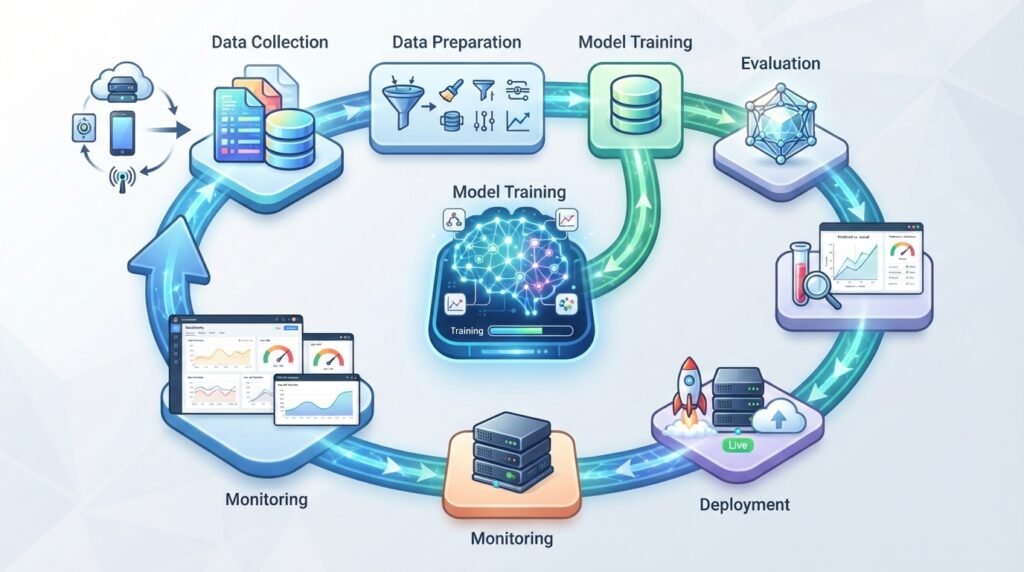
| Stage | What Happens |
| Data Collection | Relevant information is gathered |
| Data Preparation | Data is cleaned, organized, and prepared |
| Model Training | An algorithm learns patterns from the training data |
| Evaluation | The model is tested using suitable data |
| Deployment | The model is used in a real application |
| Monitoring | Results are monitored and the model may be updated |
The exact process depends on the project, but these stages provide a useful overview.
Collecting Data
Machine-learning models need suitable data to learn from.
Depending on the task, data might contain:
- Text
- Images
- Audio
- Video
- Numbers
- Sensor readings
- Customer activity
- Historical records
For example, a system designed to predict house prices might use information such as property size, location, number of rooms, and previous sale prices.
The usefulness of the model depends heavily on the quality and relevance of its data.
Preparing the Data
Raw data is rarely ready for immediate use.
It may contain missing values, duplicate records, incorrect information, inconsistent formats, or irrelevant details.
Data preparation can involve cleaning the information, organizing it into a suitable format, and selecting useful features.
Good preparation can make a significant difference to the quality of a machine-learning system.
Training the Model
During training, a machine-learning algorithm processes data and looks for useful patterns.
For example, a model trained to recognize cats in images may analyze many examples and gradually learn visual patterns that help distinguish cats from other objects.
The model’s internal parameters are adjusted during training so that its predictions become more suitable for the task.
Testing and Evaluation
A model should not only be tested on the exact examples it learned from.
A separate set of data can be used to evaluate how well the model performs on information it has not previously seen.
This helps developers determine whether the model has learned useful patterns or has simply become too specialized to its training data.
Making Predictions
Once a model has been trained and evaluated, it can be used with new data.
For example:
Input → Trained Model → Output
A spam detection system might receive a new email as input and produce an output such as:
Likely spam
The output can then be used by the application to decide what action to take.
Main Types of Machine Learning
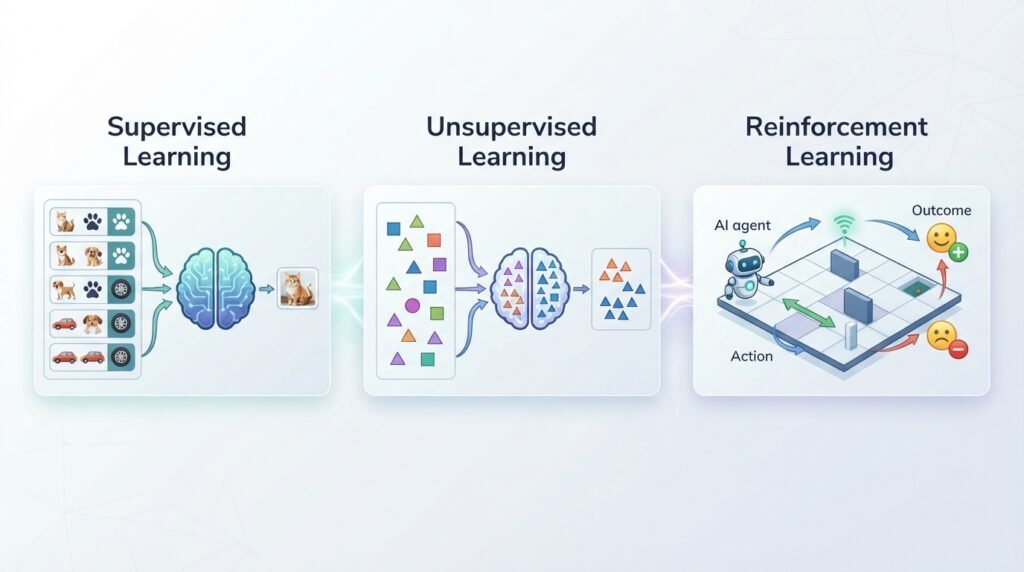
Machine Learning is commonly divided into three major categories:
- Supervised Learning
- Unsupervised Learning
- Reinforcement Learning
Each approach is useful for different types of problems.
Supervised Learning
In Supervised Learning, a model learns from training examples that include the desired answer, often called a label.
For example, suppose you want to build a system that identifies whether an email is spam.
The training data could contain:
- Email A → Spam
- Email B → Not Spam
- Email C → Spam
- Email D → Not Spam
The model uses these examples to learn patterns associated with each category.
Common Uses of Supervised Learning
Supervised learning is often used for:
- Spam detection
- Image classification
- Price prediction
- Credit-risk assessment
- Demand forecasting
- Customer churn prediction
Two common types of supervised-learning tasks are classification and regression.
Classification
Classification means predicting a category.
Examples include:
- Spam or not spam
- Fraud or legitimate
- Cat or dog
- Positive or negative review
Regression
Regression is used when the output is generally a numerical value.
Examples include:
- Predicting house prices
- Estimating sales
- Forecasting demand
- Predicting delivery times
Unsupervised Learning
In Unsupervised Learning, the training data does not contain predefined labels.
Instead, the algorithm attempts to identify useful structures or patterns within the data.
For example, a business might have information about thousands of customers but no predefined customer groups. An unsupervised-learning algorithm could help identify groups of customers with similar behaviors.
Common Uses of Unsupervised Learning
Examples include:
- Customer segmentation
- Pattern discovery
- Anomaly detection
- Data exploration
- Grouping similar documents
One common technique is clustering, where similar data points are grouped together.
Reinforcement Learning
Reinforcement Learning works differently from supervised and unsupervised learning.
An agent interacts with an environment and receives feedback based on its actions. Positive feedback can encourage useful behavior, while negative feedback can discourage unwanted behavior.
Over many interactions, the system learns a strategy that aims to improve its long-term results.
Reinforcement learning has been explored and used in areas such as:
- Robotics
- Game-playing systems
- Resource management
- Simulation
- Certain control problems
The learning process can be thought of as:
Action → Feedback → Adjustment → Better Future Action
Machine Learning vs Artificial Intelligence
Machine Learning and Artificial Intelligence are related, but they are not interchangeable terms.
| Artificial Intelligence | Machine Learning |
| Broad field of creating intelligent computer systems | A major subfield of AI |
| Includes multiple approaches | Focuses heavily on learning from data |
| Can include reasoning, planning, perception, and learning | Uses algorithms and data to learn patterns |
| Machine Learning is part of AI | Machine Learning belongs within AI |
A simple way to understand the relationship is:
AI is the larger field, and Machine Learning is one of the important methods used to build AI systems.
Not every AI approach has to rely on Machine Learning.
Machine Learning vs Traditional Programming
Traditional programming and Machine Learning solve problems in different ways.
In traditional programming, developers usually define rules and instructions directly.
A simplified example is:
Rules + Data → Program → Result
In Machine Learning, the process can look more like:
Data + Expected Results → Training Algorithm → Model
The trained model can then process new information:
New Data + Model → Prediction
This approach can be especially useful when it would be difficult to manually write rules for every possible situation.
Real-World Applications of Machine Learning
Machine Learning is used in many industries and digital services.
Recommendation Systems
Online platforms can analyze user behavior to recommend products, videos, music, articles, or other content.
For example, if a person frequently watches a particular type of video, a recommendation system may identify similar viewing patterns and suggest related content.
Fraud Detection
Financial institutions can use machine-learning systems to identify unusual transaction patterns.
A system may examine factors such as transaction amount, location, timing, frequency, and historical behavior to identify activity that deserves additional review.
Machine Learning does not guarantee that every fraudulent transaction will be detected, but it can help organizations process large amounts of activity efficiently.
Image Recognition
Machine-learning models can analyze images and identify objects, patterns, or other visual characteristics.
Applications include:
- Photo organization
- Document scanning
- Quality inspection
- Object detection
- Medical-image analysis
Voice Recognition
Machine Learning plays an important role in converting spoken language into text and interpreting voice commands.
Voice-enabled systems can use learned patterns to recognize different words, sounds, accents, and speech characteristics.
Search Engines
Search systems use sophisticated algorithms and machine-learning techniques to understand queries, evaluate information, and provide relevant results.
Machine Learning can help systems recognize relationships between words, topics, and user intent.
Cybersecurity
Machine Learning can assist security teams by analyzing large amounts of network or system activity.
It can help identify unusual patterns that may indicate suspicious behavior.
However, security professionals still need to investigate important alerts because unusual activity is not always malicious.
Healthcare Research
Machine Learning can support research and data analysis in healthcare.
Researchers can use models to identify patterns in large datasets, analyze medical images, investigate potential risk factors, and support scientific studies.
These systems require careful validation, particularly when their outputs could influence medical decisions.
Benefits of Machine Learning
Machine Learning offers several advantages when it is applied to an appropriate problem.
Handles Large Amounts of Data
A machine-learning system can process large datasets and identify patterns that would be difficult to discover manually.
Automates Certain Tasks
ML can automate repetitive prediction or classification tasks, reducing the amount of manual work required.
Improves With Suitable Data
Some machine-learning systems can become more effective as they are trained with better data and improved methods.
This does not mean every model automatically improves simply because more data is added. The data must be relevant and of sufficient quality.
Supports Personalization
Machine Learning can help applications adapt recommendations and experiences to individual users.
Helps Identify Hidden Patterns
A model can sometimes discover relationships in data that are difficult for humans to notice, especially when working with very large datasets.
Limitations of Machine Learning
Machine Learning also has important limitations.
Poor Data Can Produce Poor Results
If the training data is incomplete, inaccurate, outdated, or biased, the model can produce unreliable results.
A machine-learning model cannot automatically turn bad data into trustworthy information.
Models Can Be Biased
A model may reproduce or amplify patterns present in its training data.
For applications involving people, developers should carefully evaluate whether the model behaves fairly across relevant groups and situations.
Overfitting
Overfitting occurs when a model learns the training data too closely and performs poorly on new data.
For example, a model may appear highly accurate during training but fail when it encounters real-world examples that differ from its training set.
Requires Computing Resources
Training advanced machine-learning models can require significant computing power, storage, and technical expertise.
Results May Be Difficult to Explain
Some complex models can produce accurate predictions while making it difficult to clearly explain every factor behind a particular output.
This can be a serious concern in applications where transparency is important.
What Skills Are Needed to Learn Machine Learning?
You do not need to become an expert in mathematics before learning the basics of Machine Learning.
However, building ML systems professionally often involves several skills.
Programming
Python is widely used in machine-learning development, although other programming languages can also be useful.
Basic programming concepts such as variables, functions, loops, data structures, and file handling provide a strong starting point.
Mathematics and Statistics
Machine Learning uses mathematical and statistical concepts such as:
- Probability
- Statistics
- Linear algebra
- Optimization
The amount of mathematics required depends on the level and type of machine-learning work.
Data Handling
Understanding how to collect, clean, transform, and analyze data is an important part of practical Machine Learning.
Model Evaluation
Developers need to understand how to measure whether a model is performing well.
Different problems require different evaluation methods, and a single accuracy number does not always tell the whole story.
How to Start Learning Machine Learning
If you are a complete beginner, avoid trying to learn everything at once.
A practical learning path can look like this:
- Learn basic programming.
- Understand basic statistics.
- Learn how datasets are structured.
- Study the basic concepts of Machine Learning.
- Practice with simple datasets.
- Learn how to evaluate models.
- Build small projects.
- Gradually explore more advanced topics.
Starting with small projects can make the subject much easier to understand than simply reading theoretical material.
The Future of Machine Learning
Machine Learning is likely to remain an important part of software and technology development.
As computing systems, datasets, and algorithms continue to improve, ML can become useful for an increasing number of tasks.
At the same time, future development will need to address important issues such as data privacy, security, bias, reliability, transparency, and responsible use.
The most useful Machine Learning systems will not simply be those that produce impressive results. They will also need to be reliable, appropriately tested, secure, and suitable for the problem they are designed to solve.
Frequently Asked Questions (FAQs)
What is Machine Learning in simple words?
Machine Learning is a technology that allows computer systems to learn patterns from data and use those patterns to make predictions or produce useful results.
Is Machine Learning a type of AI?
Yes. Machine Learning is one of the major branches or approaches within the broader field of Artificial Intelligence.
Does Machine Learning require programming?
Basic programming is not required to understand the general concept of Machine Learning, but programming becomes very useful when you want to build and train machine-learning models yourself.
Which programming language is best for Machine Learning?
Python is one of the most popular choices because it has a large ecosystem of libraries and tools for data analysis, machine learning, and scientific computing.
What are the three main types of Machine Learning?
The commonly discussed types are Supervised Learning, Unsupervised Learning, and Reinforcement Learning.
Can Machine Learning make mistakes?
Yes. ML models can produce incorrect results because of poor data, bias, overfitting, unsuitable assumptions, or situations that differ from their training data.
Is Machine Learning difficult for beginners?
The basic concepts can be learned by beginners, but advanced Machine Learning can become technically demanding. Learning programming, statistics, and data handling gradually can make the process easier.
Where is Machine Learning used?
Machine Learning is used in recommendation systems, fraud detection, search engines, voice recognition, image analysis, cybersecurity, healthcare research, finance, transportation, and many other areas.
Conclusion
Machine Learning is one of the most important technologies within modern Artificial Intelligence. It allows computer systems to learn patterns from data and use those patterns to make predictions, classifications, recommendations, and other useful outputs.
From spam filters and recommendation systems to fraud detection and image recognition, Machine Learning is already being used in many services people interact with every day.
However, Machine Learning is not magic. Its performance depends on factors such as data quality, model design, testing, computing resources, and the environment in which the system is used.
Understanding these basics gives beginners a solid foundation for exploring more advanced topics in Artificial Intelligence, data science, and Machine Learning.